
Description
Convertible 2S/3S Li-ion & LiPo Boost Charging Board with USB Type-C Input, Configurable Charge Current, NTC Support & 2S Balance Connection
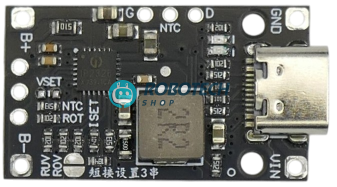
The IP2326 Type-C Lithium Battery Charger Module is a compact boost charging board designed for charging 2S and 3S lithium-ion / LiPo battery packs from a USB Type-C power source.
The module can be configured for:
✅ 2S Battery Pack → 7.4V nominal / 8.4V full charge
✅ 3S Battery Pack → 11.1V nominal / 12.6V full charge
The IP2326 uses a synchronous boost charging architecture with CC/CV lithium charging, supports configurable charging current up to approximately 1.5A, and can deliver up to about 15W charging power depending on input supply and board configuration. GitHub
এই IP2326 Type-C Charger Module 2S এবং 3S lithium battery pack charge করার জন্য ব্যবহার করা যায়। Default configuration 2S হলে 8.4V পর্যন্ত charge করে এবং board configuration পরিবর্তন করে 3S mode-এ 12.6V charging করা যায়।
It is especially useful for 18650 battery packs, robotics, portable electronics, mini UPS projects, rechargeable devices and DIY power systems.
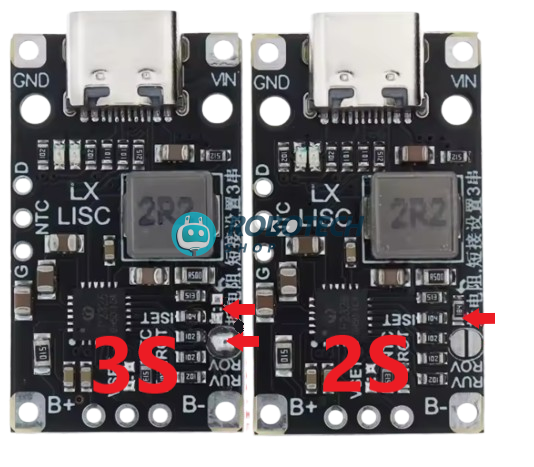
2S / 3S Convertible Feature / 2S থেকে 3S কনভার্সন
One of the main advantages of the IP2326 is that it supports both 2-series and 3-series lithium battery charging.
2S Mode
• Battery configuration: 2 cells in series
• Nominal voltage: 7.4V
• Full-charge voltage: 8.4V
• Typical use: 2 × 18650 series battery pack
• Middle-cell / BM connection can be used for 2S balancing on supported implementations
3S Mode
• Battery configuration: 3 cells in series
• Nominal voltage: 11.1V
• Full-charge voltage: 12.6V
• Suitable for 3 × 18650 series battery packs
• Requires the board to be configured for 3S mode before connection
On configurable IP2326 designs, the series count is selected through a hardware configuration/jumper associated with the IC’s CON_SEL / 3S setting. GitHub
⚠️ Important: Do not connect a 3S battery while the module is still configured for 2S operation.
Product Highlights / প্রধান বৈশিষ্ট্য
✅ Based on IP2326 lithium charging IC
✅ Supports 2S and 3S lithium battery packs
✅ USB Type-C input
✅ 2S charging voltage: 8.4V
✅ 3S charging voltage: 12.6V
✅ Boost charging architecture
✅ CC/CV lithium charging method
✅ Charging current configurable up to approximately 1.5A
✅ Up to approximately 15W charging power
✅ Multiple charge-current settings possible depending on board configuration
✅ NTC temperature sensor support
✅ Charge-status LED indicators
✅ 2S middle-cell / balance connection on compatible board implementation
✅ Compact PCB for embedded projects
✅ Suitable for Li-ion and LiPo batteries
✅ Ideal for 18650 packs, robotics and portable electronics
The IP2326 platform supports current configurations around 0.75A, 1.0A, 1.25A and 1.5A, depending on external configuration. GitHub
Applications / ব্যবহার ক্ষেত্র
• 2S 18650 battery charging
• 3S 18650 battery charging
• 7.4V rechargeable battery pack
• 11.1V rechargeable battery pack
• Robotics battery charger
• Arduino robot battery system
• ESP32 portable project
• DIY mini UPS
• Bluetooth speaker battery charging
• Rechargeable LED lighting system
• Portable electronics
• RC electronics
• IoT battery-powered device
• DIY rechargeable instrument
• Custom lithium battery projects
Package Includes / প্যাকেজে যা থাকছে
✅ 1 × IP2326 Type-C 2S / 3S Lithium Battery Charging Module
⚠️ Batteries, Type-C cable, charger adapter, NTC thermistor, BMS, wires and connectors are not included unless mentioned separately.
Technical Specifications / স্পেসিফিকেশন
• Product Type: Lithium Battery Boost Charger Module
• Main IC: IP2326
• Input Interface: USB Type-C
• Supported Battery Chemistry: Li-ion / LiPo
• Battery Configuration: 2S or 3S
• 2S Nominal Voltage: 7.4V
• 2S Full-Charge Voltage: 8.4V
• 3S Nominal Voltage: 11.1V
• 3S Full-Charge Voltage: 12.6V
• Charging Method: CC / CV
• Maximum Charge Current: Up to approximately 1.5A
• Maximum Charging Power: Up to approximately 15W
• Charge Current Settings: Approx. 0.75A / 1A / 1.25A / 1.5A depending on configuration
• Input Type: Boost charging from USB supply
• Temperature Monitoring: External NTC supported
• Status Indicator: Charging / Full LEDs depending on board version
• 2S Cell Balance Connection: Available on compatible implementation
• Recommended Use: 2S/3S rechargeable lithium battery systems
The underlying IP2326 design supports both 8.4V and 12.6V charging configurations and hardware-adjustable current/cutoff settings. GitHub
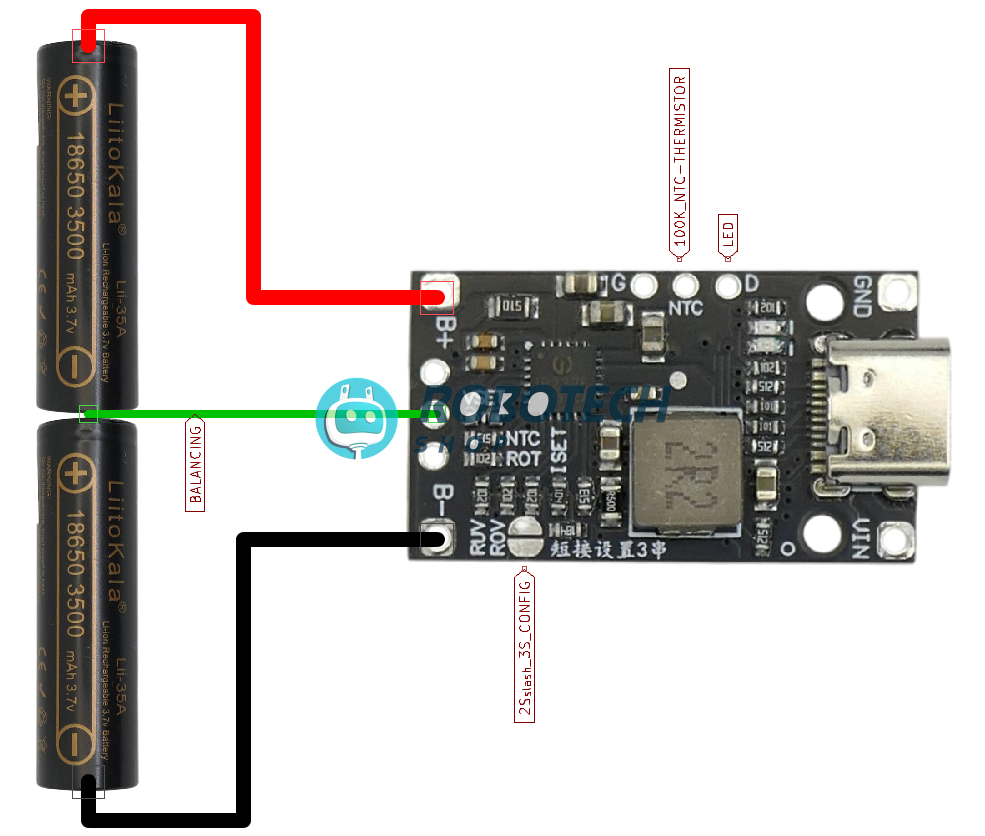
2S Battery Wiring / 2S কানেকশন
For a 2S pack:
B+
Connect to the positive terminal of the second battery / total pack positive.
BM / Balance
Connect to the junction between:
Cell 1 Positive ↔ Cell 2 Negative
B− / GND
Connect to the negative terminal of the first battery / total pack negative.
So:
Pack Positive → B+
Cell Middle Point → BM / Balance
Pack Negative → B− / GND
The BM connection is used for individual-cell monitoring/balancing on 2S implementations. GitHub
3S Battery Configuration / 3S কানেকশন
For 3S operation, the module must first be converted/configured for 3S mode.
A typical 3S pack consists of:
Cell 1 + Cell 2 + Cell 3 in series
giving:
• Nominal pack voltage: 11.1V
• Full-charge voltage: 12.6V
On configurable IP2326 boards, the 3S configuration jumper/pad changes the charger from 2S to 3S operation. GitHub
⚠️ Conversion should be performed only with all USB power and batteries disconnected.
⚠️ Exact solder pad/component location varies by PCB version. Follow the marking of the actual board instead of assuming every IP2326 PCB uses the same layout.
Important 3S Balancing Note
This point is very important.
The common IP2326 implementation provides active balancing for 2S through the BM connection, but the referenced configurable design does not provide full three-cell balancing in 3S mode. GitHub
Therefore, for a 3S battery pack:
✅ Use a proper 3S BMS / balancing protection board when required
✅ Use matched cells
✅ Make sure the three cells are at similar voltage before building the pack
✅ Do not rely on the charger alone as a complete 3S battery-management solution
Charging Current Configuration
The IP2326 supports different constant-charge-current settings.
Typical configurable values are:
• 0.75A
• 1.0A
• 1.25A
• 1.5A
The exact current depends on the installed resistor/jumper configuration. GitHub
This is useful because different battery capacities require different charging currents.
For example:
• Smaller battery → lower charging current may be safer
• Larger compatible battery pack → higher charging current can reduce charging time
⚠️ Always follow the battery manufacturer’s recommended charge current.
Charging Voltage Configuration
On advanced configurable IP2326 implementations, charge cutoff voltage can also be adjusted.
Typical options include approximately:
2S Mode
• 8.1V
• 8.2V
• 8.3V
• 8.4V
3S Mode
• 12.3V
• 12.4V
• 12.5V
• 12.6V
These options allow reduced per-cell cutoff voltage when longer battery cycle life is preferred over maximum stored capacity. GitHub
⚠️ Availability of these pads depends on the exact module PCB version.
USB Type-C Input / পাওয়ার ইনপুট
The onboard USB Type-C connector provides convenient input power.
The IP2326 uses boost conversion, meaning it can raise the lower USB input voltage to the higher voltage required by a 2S or 3S battery pack.
For best charging performance:
✅ Use a good-quality USB power adapter
✅ Use a short, low-resistance Type-C cable
✅ Make sure the adapter can provide sufficient power
✅ Avoid damaged or very thin cables
Some IP2326 implementations also support higher input/fast-charge modes, but this depends on the exact board design and input protocol support. electroxbd
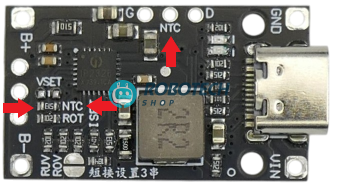
NTC Temperature Sensor Support
The board provides an NTC input for battery-temperature monitoring.
A compatible external NTC thermistor can be used to detect unsafe battery temperature during charging.
This is useful for:
• Enclosed battery packs
• Robotics
• Portable electronics
• Battery-powered instruments
• Higher-current charging applications
The configurable IP2326 reference design supports an external 100kΩ NTC thermistor. GitHub
⚠️ NTC thermistor is not included unless mentioned separately.
LED Status Indicator
The module includes charging-status LEDs.
Depending on board version, indication may show:
🔴 Charging
🟢 / 🔵 Full / Charge Complete
Exact LED colors can vary by PCB batch.
Charger vs BMS – Very Important
The IP2326 is primarily a charging controller, not necessarily a complete battery protection system for every application.
A separate BMS may still be required for:
• Over-discharge protection
• Load over-current protection
• Short-circuit protection
• Battery pack protection during use
• 3S cell balancing
For a permanent battery-powered device, using a proper 2S or 3S BMS matched to the pack is recommended.
Why Choose IP2326 Instead of TP4056?
The common TP4056 charger is mainly designed for 1S lithium batteries.
The IP2326 is more suitable when your project uses:
✅ 2S 7.4V packs
✅ 3S 11.1V packs
✅ Higher-voltage portable electronics
✅ Robotics batteries
✅ Rechargeable 12V-class DIY devices
It allows a compact USB Type-C charging solution without requiring a separate high-voltage charging adapter.
2S vs 3S Selection Guide
Choose 2S mode if your project uses:
• 2 × 3.7V lithium cells in series
• 7.4V nominal battery pack
• 8.4V full-charge voltage
• Small robot / portable electronics
• Projects requiring lower battery voltage
Choose 3S mode if your project uses:
• 3 × 3.7V lithium cells in series
• 11.1V nominal battery pack
• 12.6V full-charge voltage
• 12V-class portable electronics
• Higher-voltage motor or electronics projects
⚠️ The charger configuration must always match the battery pack series count.
Important Safety Notes / গুরুত্বপূর্ণ নোট
⚠️ Never connect a 3S battery while the board is configured for 2S.
⚠️ Never connect a 2S battery while configured for 3S.
⚠️ Disconnect battery and USB power before modifying configuration solder pads.
⚠️ Use only rechargeable Li-ion / LiPo batteries.
⚠️ Cells used in one pack should be matched in chemistry, capacity, age and condition.
⚠️ Check battery polarity carefully before connection.
⚠️ Do not short B+, B− or balance connections.
⚠️ Do not charge swollen, damaged or overheated cells.
⚠️ Select charging current according to battery capacity.
⚠️ Provide ventilation when operating near maximum charge current.
⚠️ For 3S packs, use an appropriate external BMS/balancer when required.
⚠️ Do not leave experimental lithium battery assemblies unattended while charging.
⚠️ PCB layout and configuration pads may vary depending on stock batch.
Frequently Asked Questions / FAQ
Can this IP2326 module charge both 2S and 3S batteries?
Yes. The IP2326 supports both 2S 8.4V and 3S 12.6V charging when correctly configured. GitHub
Is the module 2S by default?
That depends on the supplied PCB configuration. Check the actual module setting before connecting a battery.
Can I convert it from 2S to 3S?
Yes, on configurable versions the battery series count can be changed through the appropriate hardware configuration / 3S jumper setting. GitHub
What is the charging voltage in 2S mode?
Up to approximately 8.4V.
What is the charging voltage in 3S mode?
Up to approximately 12.6V.
What is the maximum charging current?
Up to approximately 1.5A, depending on configuration.
Can I charge 18650 batteries?
Yes. It is suitable for compatible 2S or 3S 18650 battery packs.
Does it balance batteries?
Typical implementations provide a middle-cell connection for 2S balancing. Full three-cell balancing should not be assumed in 3S mode; use an appropriate 3S BMS/balancer when needed. GitHub
Does it support NTC?
Yes. The IP2326 platform supports external NTC temperature monitoring. GitHub
Is this a complete BMS?
No. It is primarily a charging module. Additional battery protection/BMS may be required.
Can I use it in a robot project?
Yes. It is suitable for rechargeable 2S or 3S robotics battery systems.
IP2326 Type-C 2S 3S Lithium Battery Charger 8.4V 12.6V 1.5A
Buy IP2326 Type-C 2S/3S lithium battery charger module for 18650 and LiPo packs. Configurable for 8.4V 2S or 12.6V 3S charging with up to 1.5A current, NTC support and USB-C input.


