

Description
Product Description
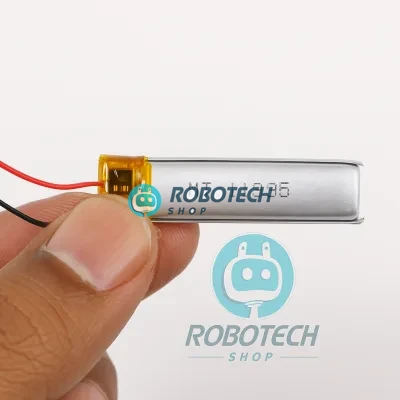
Introducing the 3.7 V 1S 500 mAh Li-Po Rechargeable Battery (6 × 45 × 25 mm) — a compact, high-energy density power source ideal for lightweight electronics, small drones, portable devices, sensors, and embedded systems. Designed with a slim and flat form factor, this battery fits into confined spaces while still delivering respectable energy output.
Despite its diminutive size, it offers reliable performance for moderate-load applications, and is best paired with appropriate charging and protection circuitry since the battery itself comes without integrated protection. It’s perfect for DIYers, makers, or product designers who want control over the battery management system but still need a compact, efficient power cell.
Key benefits include:
High energy in small size — suitable for devices where space and weight are constrained
Rechargeable & reusable — reduces waste compared to disposable cells
Wide usage scenarios — robotics, micro-drones, portable electronics, low-power IoT modules
Customizable safety with external protection — gives flexibility to integrate your own circuits
Use this cell with care, following correct charge/discharge practices and always monitoring health over its lifetime.
Technical Specifications
Below is a spec sheet — some values are based on common benchmarks or typical values for this class of LiPo cells (since the original listing is sparse on details). Be sure to confirm or test key performance metrics (especially C-rating) before deployment.
| Parameter | Value / Range | Notes / Remarks |
|---|---|---|
| Nominal Voltage | 3.7 V | Standard for 1 cell Li-Po chemistry |
| Fully Charged Voltage | ≈ 4.2 V | Do not exceed this to avoid damage |
| Cut-off / Minimum Safe Voltage | ~3.0 V | Discharging below this risks damage |
| Capacity | 500 mAh | Typical (may vary slightly by ±) |
| Energy | ~1.85 Wh | (3.7 V × 0.5 Ah) |
| Cell Configuration | 1S (1 cell in series) | No series/parallel arrangement |
| Dimensions | 6 × 45 × 25 mm | As per listing; check tolerance |
| Connector / Lead Wire | ~35 mm leads | From the listing, ~35 mm wire tail |
| Weight | (not specified) | Likely in the range of 10–20 g, based on similar cells |
| Discharge / C-Rate | (not specified) | Use conservatively unless datasheet given |
| Maximum Continuous Discharge Current | (estimate) 10–15 A | For a 20–30 C class cell; verify before use |
| Maximum Burst / Peak Discharge | (estimate) ~20–30 A | Short time bursts only, if the cell supports it |
| Max Charge Rate | ~0.5C to 1C (i.e. 0.5 A to 1.0 A) | Charge more slowly for safety and longevity |
| Protection Circuit | Not included | External protection (overcharge, overdischarge, short) required |
| Operating Temperature Range | ~ –20 °C to +60 °C | Typical for Li-Po cells, but check manufacturer spec |
| Storage / Shelf Voltage | ~3.7–3.85 V | Midpoint storage voltage is safer for longevity |
| Cycle Life | ~300–500 cycles | Varies depending on stress, usage, charge rate |
| Safety / Notes | See safety section below | Li-Po batteries require careful handling |
Safety & Usage Guidelines
To get the maximum safe lifespan and avoid hazards, here are important precautions:
Always use a dedicated LiPo charger with constant-current / constant-voltage (CC/CV) profile.
Never overcharge above 4.2 V (per cell) or over-discharge below ~3.0 V.
Since this battery has no built-in protection circuit, your system should include:
Overvoltage protection
Undervoltage / cutoff protection
Short circuit protection
Proper current limiting
Charge in a fire-safe, non-flammable area (e.g. LiPo-safe bag/enclosure).
Inspect leads, solder joints, and insulation regularly for damage.
Do not puncture, crush, bend, or apply undue mechanical stress to the battery.
Avoid exposure to high heat (above ~60 °C) or direct sunlight for extended periods.
If the battery swells, produces heat, or exhibits abnormal behavior, stop use immediately.
Store batteries partially charged (around 3.8–3.9 V) if unused for long periods.
Match the battery with an application whose current draw is comfortably within its safe continuous discharge limit.
Suggested Applications & Use Cases
Micro/nano drones or small UAVs
Portable sensor nodes, IoT devices, embedded systems
Wearables, handheld gadgets
Small robotics projects (e.g. micro-servos, microcontrollers + loads)
Backup power modules for small electronics